|
Project
ASTRO FAQs
- What
is Project ASTRO™?
-
What is a Project ASTRO site?
- Who
leads a Project ASTRO site?
- How
do we find astronomer and educator partners to participate in
the program?
- What
happens at a Project ASTRO training workshop?
- Who
trains the partners at Project ASTRO workshops?
- How
are Project ASTRO sites funded?
- What
is involved in becoming an official Project ASTRO site?
- What
interaction is there among Project ASTRO sites?
- What
is the role of the Astronomical Society of the Pacific?
- How
do I get started if I want to get a site going in my area?

What
is Project ASTRO™?
Project
ASTRO™ is an innovative national program to improve science
education by linking volunteer amateur and professional astronomers
with local educators and young people in grades 4 through 9. Developed
by the non-profit Astronomical Society of the Pacific (ASP), with
a start-up grant from the National
Science Foundation, the project provides materials, training,
and support to sustain effective partnerships between astronomers
and educators, and to get students excited about science through
astronomy. After attending a training workshop with their educator
partners, Project ASTRO astronomers "adopt" a class or
youth group for at least a year, working with them during 4 or more
visits. The underlying approach of the program is to encourage students
to think and act like scientists, by helping them engage in hands-on,
inquiry-based astronomy activities.
Back
to the FAQs
What
is a Project ASTRO site?
The
project is organized into regional sites, each encompassing one
metropolitan area or, sometimes, an entire state. Each site trains
and supports between 10 and 35 partners each year, puts on follow-up
training activities for all the local partners, and becomes a member
of the Project ASTRO National Network.
Note
that if you are unable to make a commitment to have at least 10
new partnerships a year, we encourage you to explore the possibility
of a more limited and informal Project ASTRO effort. National
Office Staff at the ASP are happy to assist in an advisory capacity
in such cases, but we are unable to designate you an official Project
ASTRO site or to send staff to your site (although you can travel
to other site workshops to learn how to do the training of the partners).
Back
to the FAQs
Who
leads a Project ASTRO site?
Each
Project ASTRO site consists of a lead institution and a Project
ASTRO coalition. The lead institution is responsible for organizing,
staffing, and fund-raising for the local project, and is typically
a science center, planetarium, observatory, college, university,
or other organization involved in science or astronomy education.
Ideally, each site will have paid staff, consisting of a part-time
director, a part-time coordinator, and a part-time administrative
assistant. In the real world of limited funding, it is at least
necessary to have a part-time coordinator who organizes and oversees
the project, and a committed individual to serve as the site director.
The site director is often a more senior scientist or educator,
who provides the support and legitimacy necessary to garner resources
within the lead institution and encourages other local organizations
to support the project.
Each
site works with a coalition of local educational, scientific, and
community groups, coming together for the purposes of finding participants,
activities, resources, and publicity for Project ASTRO (for example,
a local amateur astronomy club may put on a "star party"
at one or more schools, members of a university astronomy department
may pool educational funds from several NASA grants, and a local
school district may provide meeting rooms and let all its teachers
know about the program). Experience has shown that such a dedicated
coalition is essential to the survival and growth of the project.
Through its coalition, each local Project ASTRO actively encourages
communication and cooperation among educational and scientific groups
in their community that may otherwise not be working together.
Back
to the FAQs
How
do we find astronomer and educator partners to participate in the
project?
If
you have cast a wide net in selecting the members of your coalition,
they will most likely have many good ideas on how to enlist local
astronomer and educator partners for the project. Presentations
by project staff or coalition members to teacher conferences, astronomy
department colloquia, or amateur astronomy club meetings can be
very effective. So can articles in local newsletters, e-mail messages
distributed to special interest groups or research organizations,
and special mailings to likely candidates. The ASP can sometimes
provide the names of astronomy groups and institutions, and even
lists of astronomers (amateurs and professionals), in your local
community.
Astronomer
and educator partners complete an application form and are selected
and matched according to criteria that include location, interests,
grade level, etc. Some priority is typically given to educators
who work with young people who are traditionally underrepresented
in science due to race, gender, or socioeconomic status.
Back
to the FAQs
What
happens at a Project ASTRO training workshop?
The
two-day ASTRO workshops are typically held over a weekend (or on
Friday and Saturday) in the summer or early fall. The astronomers
and educators attend the workshop together and learn about inquiry-based
astronomy teaching, forming effective partnerships, and making use
of local and national astronomy resources. A key component of each
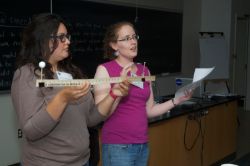
workshop is guiding the partners through several hands-on astronomy
activities from beginning to end.
During
the workshop, partners are provided with many useful materials (including
The Universe at Your Fingertips:
An Astronomy Activity and Resource Notebook and the Project
ASTRO How-To Manual) and are given guidance to help in planning
their series of classroom visits. Our astronomers and educators
are never given a prescribed set of activities, but are encouraged
to use what they learned during the workshop to develop a program
that fits with their own interests, strengths, and students' needs.
After
the workshop, astronomers make at least four visits to one classroom
or youth group. Neither astronomers nor educators receive payment
for the visits. During and between their visits, the astronomers
help the educators develop their science skills and astronomy knowledge,
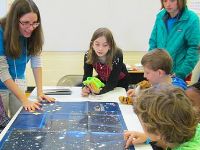
assist with hands-on classroom activities, lead discussions and
special projects, and/or serve as mentors and role models. The partners
typically engage in a range of activities, from hands-on classroom
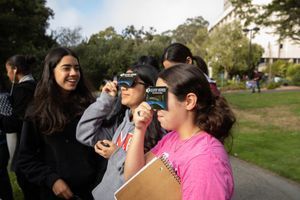
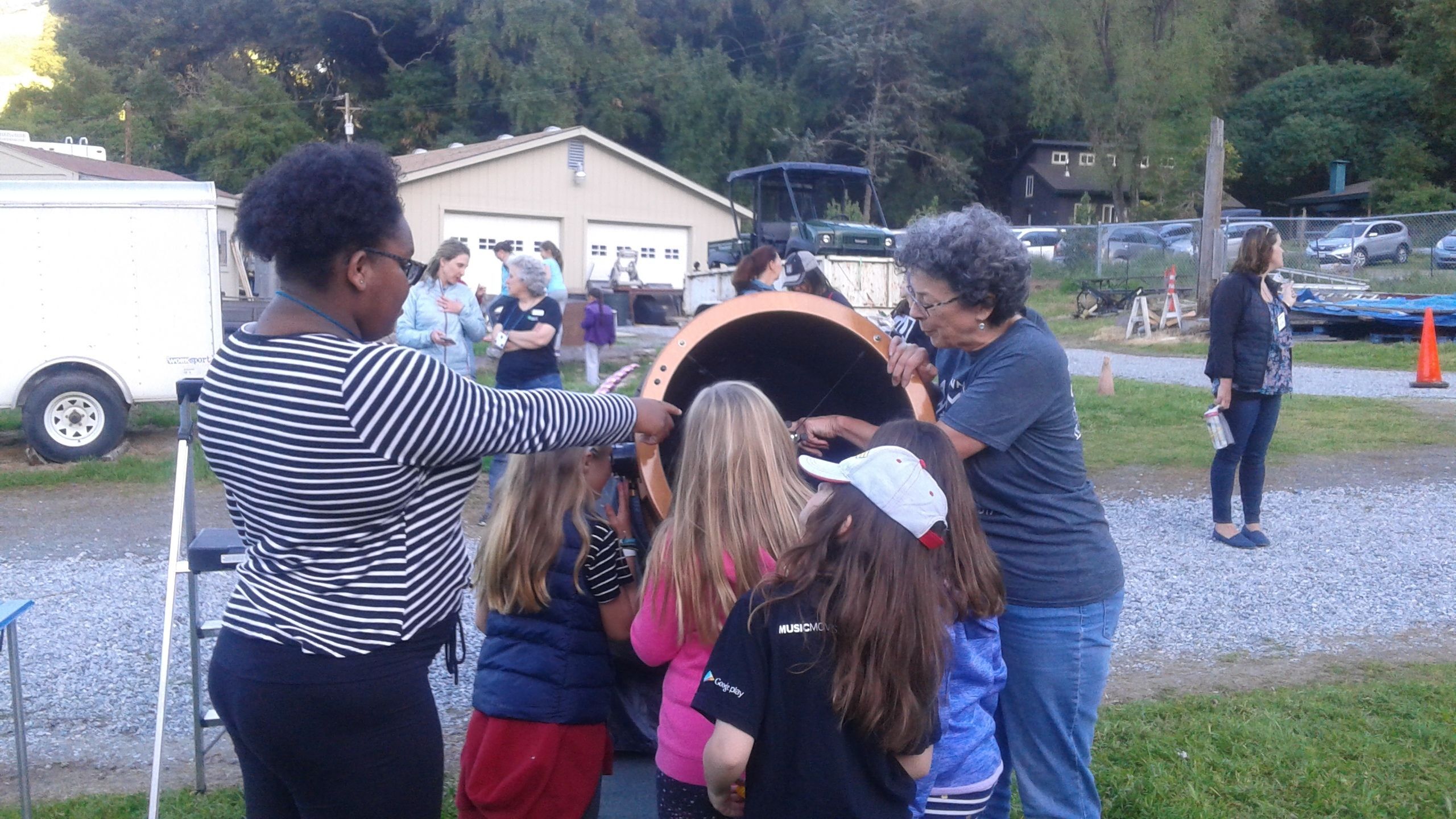
activities to school-wide events like "star parties" (evening
telescope observing sessions) for children and their families.
Back
to the FAQs
Who
trains the partners at ASTRO workshops?
The
annual training workshop for the partners is led by the local Project
ASTRO site staff, with the help of experienced astronomy educators
from the community. Often, these mentor educators will be part of
the local ASTRO-coalition institutions. The national ASTRO staff
will provide workshop templates and discuss the workshop design
and philosophy with the staff of each new site.
If
necessary, new site leaders can receive training in organizing a
good workshop. If the new site is able to fund it, representatives
from the National Project ASTRO Staff
can attend and co-lead the first workshop. In this way, current
and future workshop leaders from the local site can see demonstrated
some of the workshop techniques that have been developed elsewhere.
Alternatively, your staff can attend a workshop for partners at
one of our existing Project ASTRO sites.
Back
to the FAQs
How
are Project ASTRO sites funded?
While
the National Science Foundation provided start-up funds for the
Project ASTRO National Network, at
the present time all Project ASTRO sites must provide their own
funding. Among the sources of funding that the various sites have
been successful in tapping are:
- Donations
from local corporations, foundations, and individuals.
- Education
and outreach components of NASA or NSF grants (sometimes pooled
from several local investigators or research projects).
- NASA
Space Grant or other NASA educational program funds.
- State
education funds (many states have special programs to which you
can apply, often with help from knowledgeable members of your
coalition).
- In-kind
support from coalition institutions (such as meeting space, free
mailings, underwriting of administrative costs, etc.).
Back
to the FAQs
What
is involved in becoming an official Project ASTRO site?
A Project
ASTRO site must share and support the goals and methods of the project,
as described above. Note that you do not need to be a Project ASTRO
site to purchase and use such project materials as The
Universe at Your Fingertips from the ASP
catalog. But if you do wish to become a site, you will be asked
to complete a Project ASTRO application, outlining your plans for
getting your site going and obtaining funding to cover its expenses.
Once your application has been reviewed and accepted, your institution
will be asked to sign a Memorandum of Understanding (MOU) with the
Astronomical Society of the Pacific. The MOU is reviewed annually,
and each site is asked to make a brief annual report to the ASP.
Back
to the FAQs
What
interaction is there among Project ASTRO sites?
All
official Project ASTRO sites are linked into a National
Network of site leaders, which meets annually and keeps in touch
regularly. Experienced site leaders are often available to answer
questions from new or prospective sites about issues or problems
that come up in getting a site started. Good ideas originating at
one Project ASTRO site are quickly shared among all of them through
this network.
Back
to the FAQs
What
is the role of the Astronomical Society of the Pacific?
The
ASP coordinates the national Project ASTRO effort from its offices
in San Francisco, and holds the trademark and copyright on the program
and its materials. All Project
ASTRO materials are published by the ASP, and distributed to
official Project ASTRO sites at a significant discount from retail
prices. The ASP provides training and guidance for new site leaders,
sends leaders for the first workshop when possible, and develops
new and revised materials for all Project ASTRO partners to use.
In addition, the ASP will provide free templates for commonly used
Project ASTRO materials (such as educator and astronomer applications,
site news releases, local newsletters, workshop handouts, etc.)
to all official Project ASTRO sites. One of the main roles of the
ASP is to ensure the philosophical integrity of the project among
the sites.
Back
to the FAQs
How
do I get started if I want to get a site going in my area?
The
first step is to gauge interest in Project ASTRO locally. The natural
first contacts to make are with the local astronomy community, including
university and community college astronomy departments and the amateur
astronomy clubs in your area. We find that it is seldom difficult
to interest local teachers in Project ASTRO; most teachers love
the idea of having "their own astronomer." It is really
those individuals whom you are going to be tapping as astronomer
volunteers who must be courted. The next step is to set up a local
coalition of individuals and organizations that have an interest
in astronomy education. Host a meeting to talk about Project ASTRO
and the ways in which it can positively impact the community and
those in attendance. Be sure to bring up the issue of fundraising
and solicit input from those present as to possible organizations,
businesses, and individuals that might be interested in supporting
the project (you may want to have information about the project,
and a copy of The Universe
at Your Fingertips and the Project
ASTRO How-to-Manual at the meeting to show everyone).
If
there is local interest, contact the ASP more formally and speak
with our National Project ASTRO Staff.
We can offer advice and direct you to other Project ASTRO sites
resembling your own. These sites can help by identifying and addressing
challenges before they arise, providing customized materials for
recruiting and publicity, and perhaps even serving as informal advisors
as you begin your activities.
Back
to the FAQs
Project
Director: Andrew Fraknoi
Project Coordinator: Suzanne Gurton
Return
to Project ASTRO: Getting Involved
Return to Project ASTRO Home Page
|